STAR: Super Tricky Amazing Run
- 4.2
- Rating
- 100.00M
- Installs
- Free
- Price

 Analysis by App-foxy
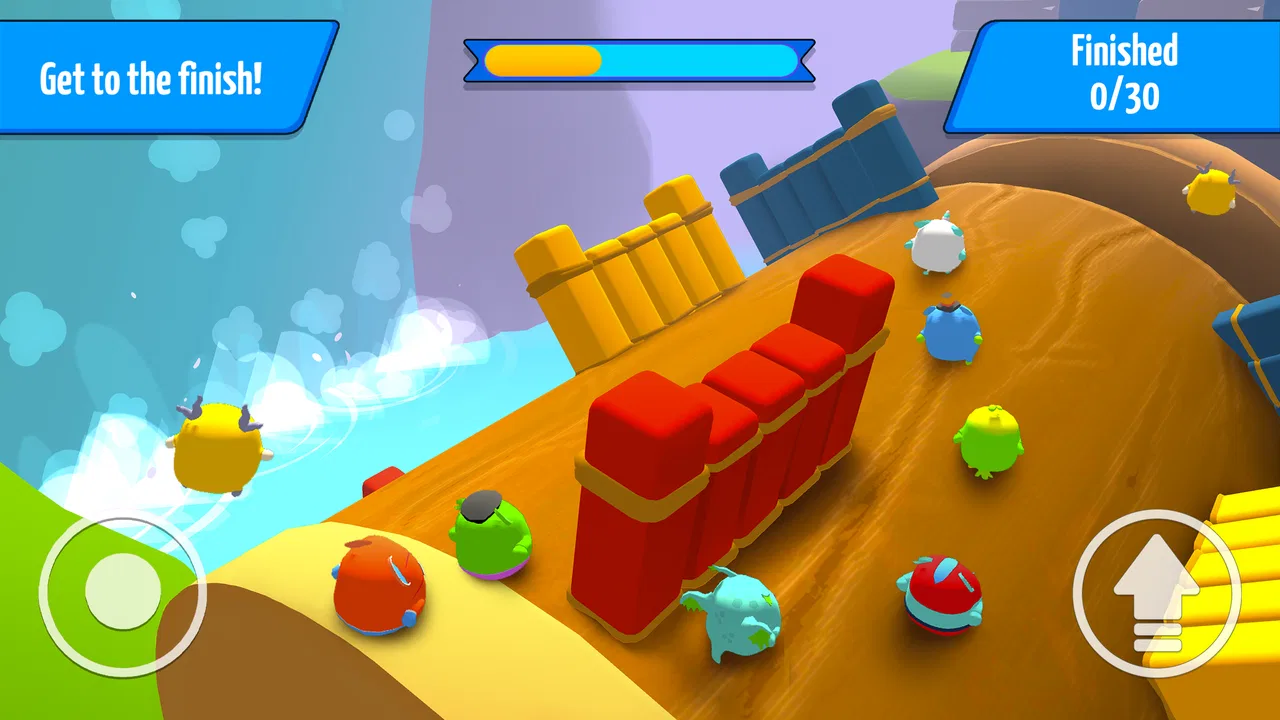
I spent time with STAR: Super Tricky Amazing Run as the kind of quick arcade game you open when you want immediate action rather than a long setup. Its appeal is easy to understand: you guide a character through a knockout-style race, try to stay upright, and deal with the chaos of stumbling, falling, and recovering while other competitors push toward the finish. It is free to download, aimed at Everyone, and made by CASUAL AZUR GAMES.
That simple premise hides a surprisingly useful test of patience. The controls are easy to approach, but the timing pressure makes each run feel more demanding than the store summary suggests. I found it best in short sessions, especially when I had a few spare minutes and wanted something more active than a passive time-killer. It is not a deep arcade campaign with a carefully developed story, but it does offer the immediate loop many people want from a mobile knockout racer: start, react, survive the obstacles, and try again.
How the game feels when the pace picks up
The first thing I noticed was how quickly the game gets to the point. There is little reason to treat it like a slow, methodical puzzle. The useful skill is reading the path ahead, making small adjustments, and avoiding the kind of rushed movement that sends you into trouble. The perceived speed comes less from complicated controls and more from the pressure to make decisions before the course gets away from you.
You May Also Like

 Blood Strike: 2.5 Anniversary
Blood Strike’s Loadouts Turn Every Drop Into a Tactical Gamble
A close look at Blood Strike’s custom loadouts: how fast access to signature weapons reshapes its battle royale rhythm, rewards preparation, and narrows the gap between fights.

 Pandora - Music & Podcasts
Pandora’s Music Is Easy to Start, but Harder to Recover
Pandora’s strength is its low-effort path from a seed to a station. Its weak spot is how much confidence it asks you to place in connection, setup, and quiet recovery.

 8 Ball Pool
 Is Built on Rivalries, Rematches, and Routine
A close look at the rivalries, rematches, shared routines, and unanswered safety questions that turn a quick pool match into a persistent mobile community.

 Samsung Music
’s Quiet Strength Is Playing What You Already Own
Its reach comes less from spectacle than from dependable access to a personal library. That simplicity is both the app’s strongest retention engine and its ceiling.

 AccuWeather: Weather Radar
AccuWeather Review: A Quick, Clear Forecast for Everyday Decisions
For everyday plans, the best forecast is the one you can understand quickly. AccuWeather makes rain timing, radar, and local conditions easy to act on, with a few trade-offs.

 Hill Climb Racing
Why Hill Climb Racing Still Turns Crashes Into One More Run
A tiny car, a bumpy hill and one more upgrade: Hill Climb Racing keeps resurfacing because its simple chaos makes every near-miss feel personal.
More From Our News Desk



That makes the game approachable for a casual player, but not necessarily relaxing. A newcomer can understand the basic objective almost immediately, while a more experienced arcade player will start looking for better lines through the course and safer moments to move. I liked that distinction. The controls do not create a large learning barrier, yet the race can still punish careless reactions.
In practice, I recommend beginning with controlled movements rather than constantly trying to move as fast as possible. When the route becomes crowded or visually busy, a short pause in your decision-making can be more valuable than a desperate correction. This is one of the less obvious lessons in the game: survival often matters more than the most aggressive route. A player who stays upright usually has a better chance than one who gains a little ground and then loses time recovering.
The speed also affects how suitable the game is for different moods. If I want a calm experience with predictable progress, this is not my first choice. If I want a brisk challenge that can fill a short break, the format works much better. The action is easy to start, but the repeated need to react gives each attempt a little more tension than a purely idle arcade title.
What happens when the screen gets busy
The most demanding moments are not necessarily the opening seconds. They arrive when several things compete for attention: the shape of the route, the movement of nearby runners, and the need to recover after a mistake. That combination can make a simple course feel much less simple. I found myself improving not by memorizing a single perfect sequence, but by learning when not to commit to a risky move.
Heavy-use moments are also where the game’s design becomes most divisive. Players who enjoy unpredictable races may appreciate the pressure and the occasional reversal of fortune. Players who prefer complete control may find the same situations frustrating, particularly when a failed attempt feels caused by crowding or a poorly timed recovery rather than a clear strategic error.
For everyday use, I would play it in focused bursts instead of while multitasking. A short commute, a waiting room, or a break between chores can suit it well if you can give the screen your attention. It is a poor companion for half-watching television or answering messages because the important decisions arrive quickly. Even a brief distraction can turn a manageable section into a fall.
One practical habit helped me: I stopped treating every stumble as a disaster. Recovery is part of the rhythm, and immediately forcing another movement can make the situation worse. Waiting for a stable moment before choosing the next direction is often the smarter response. That approach is especially useful for younger players, who may otherwise respond to a mistake by tapping more quickly and creating another one.
Why short sessions work better than marathon play
The game’s structure naturally favors repeat attempts. That can be satisfying when I am chasing a better result, but it can also become repetitive during a long sitting. The core attraction is the race itself, not a large collection of unrelated activities, so the experience depends heavily on whether I enjoy refining reactions and handling setbacks.
For that reason, I see it as a strong “one more try” game rather than a title I would recommend for an entire evening every day. A few attempts can feel energetic and rewarding. Much longer sessions may expose the limits of the simple loop, especially if I am not in the mood to tolerate repeated falls or similar patterns of challenge.
There is also a useful trade-off between accessibility and depth. The uncomplicated presentation helps a child or a first-time arcade player begin without studying instructions, but it leaves less room for the kind of long-term strategic development found in more elaborate racing games. If you want vehicle tuning, detailed tracks, or a substantial single-player progression system, you should look elsewhere. If you want fast obstacle-focused runs, the lighter structure is part of the appeal.
Reliability, installation, and everyday practicality
My overall impression is that the game is designed to be easy to pick up and return to. It belongs to the arcade category, has passed a large adoption threshold with over 50 million installs, and carries an average rating of 4.2 from around 252 thousand ratings. Those figures do not replace personal testing, but they do suggest that the basic concept has reached a broad audience rather than serving only a narrow group of arcade specialists.
The current version is 2.20.8.0, and the listed minimum requirement is Android 8.0. That makes it relevant to people using older compatible phones, although compatibility alone does not guarantee identical smoothness on every device. A newer phone may handle busy scenes more comfortably, while an older model can be more sensitive to heat, background activity, or limited free storage.
I would not choose this game expecting a completely uniform experience across all hardware. Arcade action depends on timing, so even small interruptions can feel more noticeable than they would in a turn-based game. If the phone is already busy with downloads, navigation, music, or several open apps, closing unnecessary background tasks is a sensible preparation before playing. This is not a claim about a specific technical fault; it is simply good practice for any timing-focused mobile game.
Recovery after an interruption is another practical consideration. If a notification pulls your attention away, the best response is usually to treat the current attempt as compromised rather than trying to force an immediate correction. I found that restarting with a clear focus was less frustrating than continuing while distracted. That makes the game easy to fit into a break, but not ideal when your break is likely to be interrupted repeatedly.
Resource demands and device limits
The game is not presented as a heavyweight simulation, and its arcade identity suggests a lighter commitment than a large open-world title. Still, I would avoid promising identical battery use or temperature behavior on every phone. Screen brightness, network conditions, system age, and other running apps can all affect how demanding a session feels.
Players with entry-level or older hardware should pay attention to how the game behaves during crowded sections rather than judging it only from the opening. The moments with more movement and visual activity are the ones that matter most for a timing game. If those sections feel delayed or uneven on your phone, the experience may become frustrating even if menus and quieter moments appear fine.
There is also a storage and maintenance angle. Keeping the operating system reasonably current, leaving some free space, and avoiding a nearly full device can reduce avoidable friction. I would not install it on a phone that is already struggling with general responsiveness and then blame the game for every pause. On a well-maintained compatible device, the lightweight arcade format is more practical than a demanding 3D adventure, but the real test is still your own handset during active play.
The age rating of Everyone makes it suitable for a broad audience, which is useful for families looking for a straightforward arcade game. Adults should still remember that the game includes in-app purchases ranging from $0.99 to $99.99 per item. The free entry point is attractive, but I would review purchase controls before handing the phone to a child. That is a practical household step, not a criticism of the racing concept itself.
Where the free model changes the decision
Because the game is free, the main question is not whether it is worth an upfront purchase. The more important question is whether you are comfortable with a free-to-play environment that offers optional purchases. I can recommend trying it without financial commitment, but I would not recommend spending automatically just because a difficult run went badly.
My advice is to play long enough to decide whether the basic movement and retry loop genuinely hold your attention. If you are already enjoying the challenge, optional spending becomes a personal choice. If the core race feels repetitive or frustrating, a purchase is unlikely to solve that underlying mismatch. In other words, the free access is a useful trial, and it should be treated that way.
This also affects who should skip it. Players who dislike in-app purchase prompts, repeated retry cycles, or games built around quick competitive pressure may be happier with a paid arcade title or a puzzle game with a fixed structure. Likewise, anyone seeking a rich narrative, precise simulation, or deep customization will probably find the experience too focused on immediate obstacle racing.
How it compares with familiar arcade alternatives
Compared with a traditional endless runner, this game feels more like a contest than a private score chase. The presence of a knockout-race idea gives mistakes a social, competitive flavor, even when the controls remain simple. An endless runner may be better if you want to concentrate on personal distance and gradually improve a single uninterrupted run. This title is a better fit when you enjoy the drama of staying in the race while the course creates pressure.
Compared with a kart racer, it is much less about vehicle handling, track mastery, or tuning. There is no reason to approach it as a substitute for a detailed racing simulation. Its strength is the physical comedy and quick reaction loop around running, stumbling, and recovering. That makes it more approachable for a mixed-age group, but also less satisfying for players who want technical control over speed, braking, and vehicle setup.
Compared with a conventional platformer, the emphasis is also different. A platformer may reward careful jumping and exploration, while this game’s attraction is the race atmosphere and the risk of being knocked out by a mistake. If you enjoy experimenting with routes and repeating a difficult section until every input is exact, a traditional platformer may offer more precision. If you prefer short, lively attempts where the situation can change quickly, this game has the stronger case.
Who I would recommend it to
I would recommend it to players who want a free arcade game that starts quickly, works well in short bursts, and does not require a long explanation before the first attempt. It is particularly suitable for families and casual players who enjoy playful competition, visible mistakes, and the satisfaction of improving through repetition.
I would also suggest it to someone who normally avoids complicated games but still wants a little tension. The basic idea is understandable, and the challenge comes from timing and recovery rather than from learning a large set of systems. A parent could use it as a simple shared game, provided purchase settings are handled first and the child understands that falling is part of the experience rather than a reason to tap wildly.
I would skip it if I wanted a quiet game for distracted play, a substantial story, or a long-term progression system with many different forms of content. I would also be cautious if my phone was old, crowded with background tasks, or prone to slowing down during active games. Timing-based arcade play has less patience for device interruptions than slower genres.
My performance verdict
After weighing the speed, busy moments, device considerations, and free-to-play structure, I see this as a focused arcade recommendation rather than an all-purpose mobile game. Its best quality is immediacy: I can start a run quickly, understand what went wrong, and decide whether to try again. Its biggest limitation is that the same focused loop can feel repetitive or frustrating when I play for too long.
The game’s broad reach, Everyone rating, and free price make it easy to test, while the Android 8.0 requirement keeps the entry barrier reasonable for compatible users. The developer, CASUAL AZUR GAMES, has positioned it as a straightforward knockout race, and that focus is clear in actual use. I would not promise identical performance on every handset, but a sensible test is simple: play through the busiest sections on your own phone and judge whether movement remains comfortable and responsive.
My final recommendation is to try it for short, focused sessions and decide based on the feel of recovery and repeated races. If you enjoy quick reactions, playful setbacks, and the urge to improve the next attempt, it can become a dependable break-time game. If you need calm pacing, deep progression, or a purchase-free experience, another arcade option will likely suit you better. For the right player, the appeal is not complexity; it is the small burst of tension created by trying to stay on your feet long enough to finish.
FAQs for STAR: Super Tricky Amazing Run
01What is STAR: Super Tricky Amazing Run all about?
STAR: Super Tricky Amazing Run is a dynamic and engaging platform game where players navigate through challenging obstacle courses. The game offers a blend of action, strategy, and quick reflexes, requiring players to overcome various hurdles to reach the finish line. It’s perfect for those who enjoy fast-paced, skill-testing games.
02Is STAR: Super Tricky Amazing Run free to play?
Yes, STAR: Super Tricky Amazing Run is free to download and play. However, like many mobile games, it offers in-app purchases. These can range from cosmetic enhancements for your character to items that can help you progress more easily through the levels. Be sure to check your device’s settings to manage purchases.
03What are the main features of STAR: Super Tricky Amazing Run?
The game boasts numerous features, including a variety of challenging levels, vibrant graphics, and smooth controls. Players can also enjoy multiplayer modes, allowing them to compete with friends or other players worldwide. Additionally, regular updates bring new levels and features, keeping the gameplay fresh and exciting.
04Does STAR: Super Tricky Amazing Run require an internet connection?
While you can enjoy some aspects of STAR: Super Tricky Amazing Run offline, a stable internet connection is recommended for the best experience. Multiplayer modes and certain events require online connectivity to function correctly, ensuring you can compete with others and receive the latest updates and content.
05What devices are compatible with STAR: Super Tricky Amazing Run?
STAR: Super Tricky Amazing Run is available on both Android and iOS platforms. It supports a wide range of devices, but it’s always best to check the specific system requirements on the app store to ensure compatibility. Regular updates might also affect compatibility, so keeping your device’s software up to date is advisable.
Pros
- Engaging and colorful graphics
- Intuitive controls and gameplay
- Variety of challenging levels
- Regular updates with new content
- Multiplayer mode for added fun
Cons
- Occasional in-app ads disrupt play
- Requires internet for multiplayer
- Limited customization options
- Some levels feel repetitive
- Can be challenging for beginners

STAR: Super Tricky Amazing Run
Gallery